
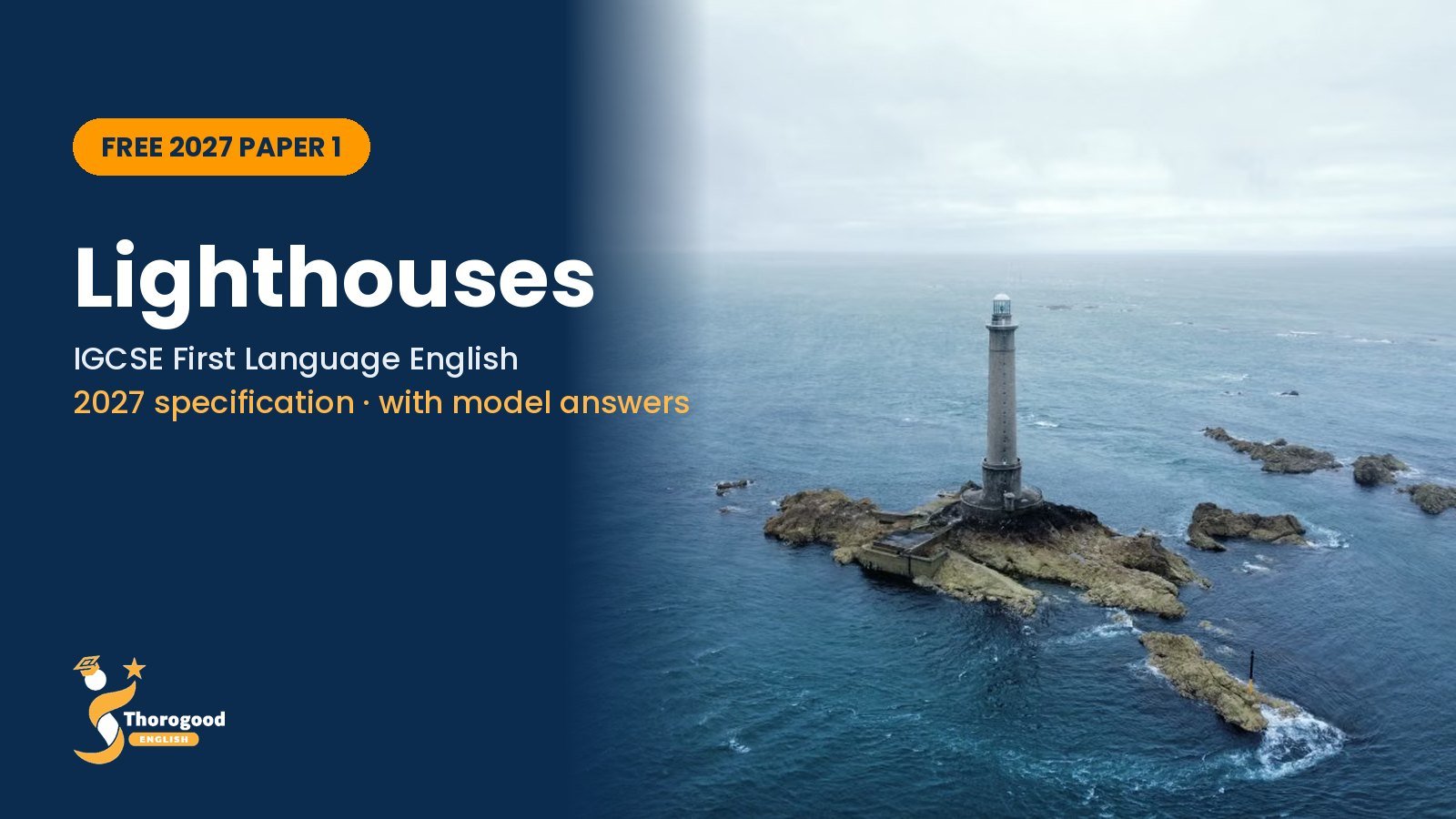
From 2027, Cambridge IGCSE First Language English Paper 1 has a new shape: three texts, a summary built around a writer’s views, a writer’s-effect question on the narrative, and an extended response written from inside the story. There is only one specimen paper so far, which means students have almost nothing to practise on. Lighthouses is a complete, full-length mock written for the new format – and it’s free.
The three texts
- Text A: The keepers who vanished (non-fiction) – the 1900 mystery of the three keepers who disappeared from the Flannan Isles lighthouse, off the Outer Hebrides.
- Text B: Keep the lights burning (opinion article) – a yacht skipper of thirty years argues that lighthouses still matter in an age of satellite navigation.
- Text C: The night the light stood still (narrative) – in the 1960s, sixteen-year-old Nell spends the summer with her father, the principal keeper of Gannet Rock, twenty kilometres from the mainland.
The theme links all three: isolation, duty and what we lose when something old is switched off. Question 4 asks students to write Nell’s journal entry.
What’s inside
- The insert with all three texts, line-numbered just like the real thing
- The full question paper: Questions 1(a)–(f), 2(a)–(b), 3(a)–(d) and 4, 80 marks, 2 hours
- A detailed mark scheme set out in the familiar Cambridge table layout
- All 12 summary points, plus model answers for 2(a), 2(b), 3(c), 3(d) and Question 4
- Level descriptors written in plain English, so students can mark their own work
How to use it
Sit it as a timed mock in two hours, ideally once the course content has been covered. Then go through the mark scheme question by question: the model answers show what a top-band response looks like, and the 3(d) model shows exactly how to pick and explain three precise choices. Students working alone can mark Questions 1 to 3 themselves and use the level descriptors to place their Question 4.
Teachers are welcome to use the paper with their own classes. If you try it, I’d love to hear how your students get on.