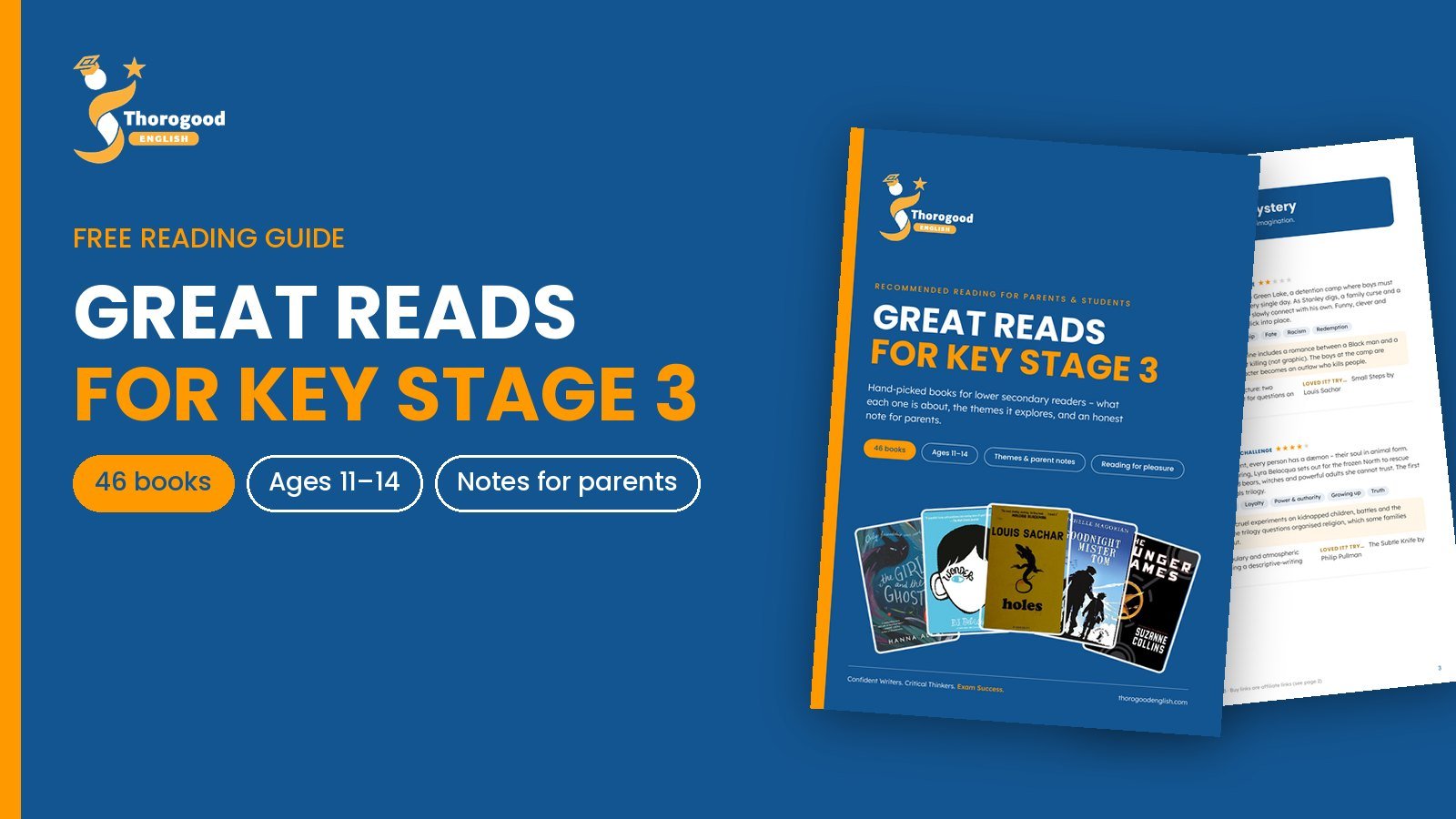
“What should my child be reading?” It’s the question parents ask me more than any other – at parents’ evenings, at the school gate, and in my inbox. So I’ve put my answer into one free guide: 46 books that 11–14-year-olds genuinely enjoy, each with an honest note for parents.
Reading for pleasure is one of the best things a young person can do for their English. It builds vocabulary, shows them how good writers hook a reader, and gives them ideas for their own writing. (If you’d like the evidence, I’ve written about it in Why Reading Fiction Improves Exam Performance in English.) But the key word is pleasure. A book a child is made to read rarely does as much good as one they can’t put down.
What makes a good book list for 11–14s?
Lower secondary is a tricky age for reading. Children are moving on from younger fiction but aren’t ready for everything written for older teenagers. So every book in the guide was chosen with three things in mind:
- Enjoyment first. These are books young people choose to read, not set texts.
- Range. Adventure, mystery, real-life stories, classics, true stories – and Asian voices, including two novels by Malaysian author Hanna Alkaf.
- Honesty for parents. Every book has a clear note on anything sensitive, and books for confident readers of 14+ are marked “Upper KS3 only”, so there are no surprises.
Six books to start with
- Holes by Louis Sachar – a funny, clever mystery about a boy wrongly sent to a desert detention camp.
- Wonder by R.J. Palacio – a boy with a facial difference starts school for the first time.
- The Girl and the Ghost by Hanna Alkaf – a lonely Malaysian girl and a jealous spirit companion, rooted in Malay folklore.
- Boy 87 by Ele Fountain – a gripping story of one boy’s dangerous journey to safety.
- Goodnight Mister Tom by Michelle Magorian – a wartime classic about an evacuee and the gruff old man who takes him in (moving and sometimes upsetting – one to talk about together).
- I Am Malala (Young Readers Edition) – the true story of a girl who stood up for every child’s right to go to school.
Books for the tricky moments
Sometimes a story is the gentlest way into a difficult conversation. The guide has a “Find a book by topic” index, so you can find a book about what your child is going through – Restart for bullying, The Suitcase Kid for divorce and living between two homes, The Goldfish Boy for anxiety, or A Monster Calls for grief.
How to help your child find their next book
- Let them choose. Show them the guide and let them pick – a book they choose is a book they’ll finish.
- Short books count. Look for the “Quick read” badge if your child finds long books daunting.
- Graphic novels count too. Smile by Raina Telgemeier has won over many reluctant readers.
- Talk about it. Ask what they’re enjoying – or read the same book and compare notes.
Download the free guide
Great Reads for Key Stage 3 is a 21-page PDF. Every book has its real cover, Page-turner and Challenge star ratings, the themes and issues it explores, an honest note for parents, a skill boost showing how it helps with English, and a “Loved it? Try…” suggestion for what to read next.
UK families can buy any book directly from the guide through Bookshop.org, which supports independent bookshops. Families abroad will find these books in most good bookshops – in Malaysia, try Kinokuniya, MPH, Popular or BookXcess – and in school libraries.
If your child is in Key Stage 3 and you’d like them to build real confidence in English – including preparation for Cambridge Lower Secondary Checkpoint – take a look at my small live classes. And if you have an older teenager, there’s a Great Reads for Key Stage 4 guide too.