Category: Writing Skills

Techniques and strategies for stronger English writing — from descriptive language and sentence variety to essay structure, grammar, and exam-ready analytical style.

  • How Good Writing Habits Help in Every Subject, Not Just English

    Students who are reluctant about English sometimes need reminding of something that becomes obvious later: the ability to write clearly, structure an argument, choose the right word, and communicate persuasively is not a skill confined to English lessons. It’s the skill that underlies success in almost every other academic and professional context. Here’s why.

    History and the Humanities

    History exams test essay writing. Geography exams test report writing. Philosophy and ethics exams test argumentative writing. The student who can structure an analytical essay, deploy evidence precisely, and write a well-reasoned conclusion will outperform a student with equivalent knowledge but weaker writing ability in every one of these subjects. The marking criteria are different from English, but the underlying writing skills are the same.

    Science and Maths

    At A-Level and beyond, science and maths increasingly require clear written communication — experiment reports, extended answer questions, university application personal statements, research proposals. The scientist who can explain their work clearly in writing has a significant advantage over one who can’t. Many scientists are poor writers, and they know it; the ones who aren’t stand out.

    University

    Almost every undergraduate degree involves essay writing — even those in STEM fields involve dissertations, research reports, and lab write-ups. The students who struggle most in their first year at university are often those who coasted through secondary school in English and arrive at degree-level written work without the foundational skills to meet the standard required.

    Professional Life

    Emails, reports, proposals, presentations, job applications, client communications — professional life is full of writing, and professional advancement is significantly shaped by the quality of it. The ability to write a clear, well-structured email is genuinely rarer than it should be; the person who can do it well is noticed.

    The University Personal Statement

    For UK students, the UCAS personal statement is perhaps the most consequential single piece of writing a student will produce before the age of 18. It requires exactly the skills English teaches: analytical argument, evidence, structure, vocabulary, and the ability to present yourself persuasively in writing. Students who are strong writers write better personal statements. It’s as simple as that.


    At Thorogood English, we build the writing skills that matter not just in English exams but in every academic and professional context your child will encounter. Join the waiting list for January 2027.

  • The Importance of Punctuation in IGCSE English Writing

    Many students think of punctuation as a set of rules to be followed or avoided — a minefield of commas where wrong answers lose marks. The better way to think about it: punctuation is a tool for controlling how your writing is read. Used deliberately, it shapes pacing, creates emphasis, manages tone, and makes complex ideas clear. Here’s how to use it that way.

    The Full Stop

    The most underrated punctuation mark. A short sentence followed by a full stop creates impact. Students who write exclusively in long, multi-clause sentences lose the power of the short sharp statement. Varying sentence length — including using very short sentences of three to five words — is one of the clearest markers of a confident, controlled writing voice. Full stops earn you that control.

    The Comma

    The comma is the most versatile punctuation mark and the most commonly misused. Its legitimate functions: separating items in a list; separating a subordinate clause from a main clause; separating a fronted adverbial from the rest of the sentence; marking a pause in direct speech. Its most common misuse: the comma splice — joining two independent clauses with a comma where a full stop, semicolon, or conjunction is needed. (“It was raining, we stayed inside.” — should be “It was raining. We stayed inside.” or “It was raining, so we stayed inside.”)

    The Semicolon

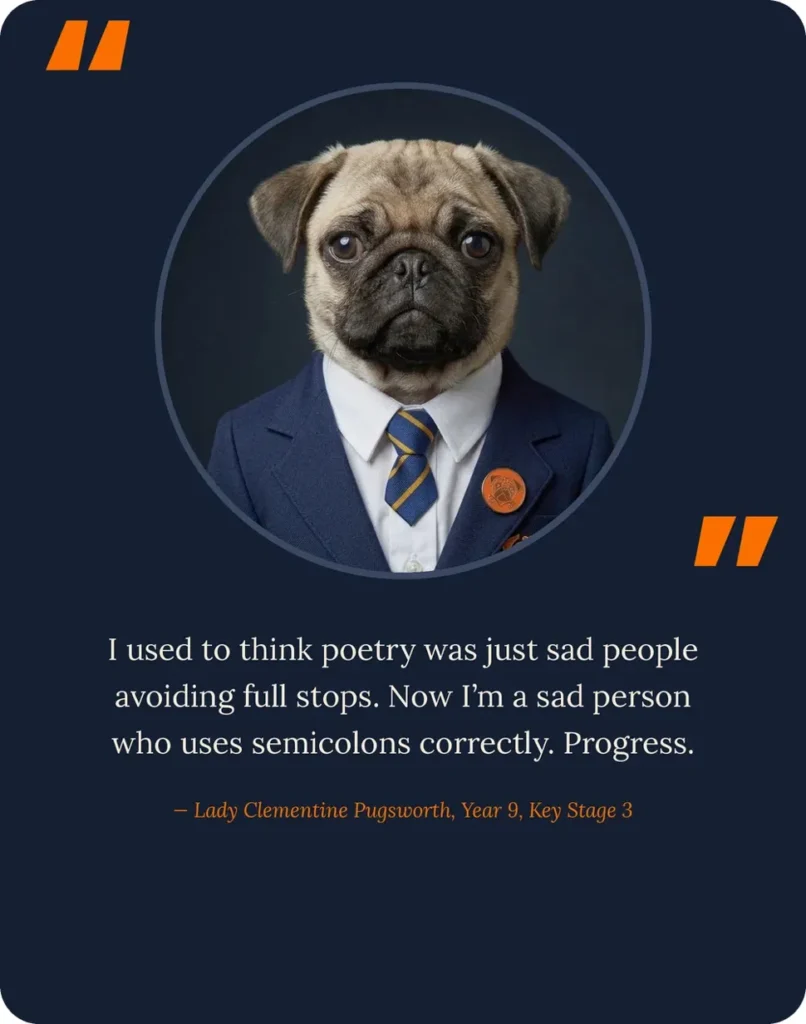
    The semicolon joins two independent clauses that are closely related in meaning; it signals that the two clauses should be read together. It’s slightly more formal than a full stop, slightly more emphatic than a comma. Used once or twice in a piece of writing, it signals stylistic control. Used frequently, it becomes distracting. Learn it, use it occasionally, use it correctly.

    The Dash

    The dash is versatile and — used well — adds energy and informality. It can introduce an afterthought, a clarification, or an emphatic aside. In creative and discursive writing at IGCSE, it’s a legitimate stylistic choice. In formal letters or reports, use it sparingly if at all. The em dash (—) and the en dash (–) are technically different; in practice, using either consistently is fine.

    Ellipsis

    Three dots (…) indicating something left unsaid, a trailing thought, an unresolved tension. In creative writing, used deliberately at the right moment, it’s powerful. Used reflexively throughout a piece — whenever the writer isn’t sure what comes next — it signals a loss of control rather than deliberate craft. Use ellipsis purposefully: ask what you want the reader to feel in the gap.


    Punctuation, sentence control, and writing craft are developed across every level at Thorogood English. Join the waiting list for January 2027.

  • How to Improve Your Child’s Spelling: Strategies That Actually Work

    Spelling is one of those areas where well-meaning effort often produces poor results. Writing out a word ten times, testing on a list of twenty words, and then forgetting them all a week later is a familiar cycle for many families. Here are strategies that work better — and why they work.

    Why Rote Repetition Often Fails

    Writing a word repeatedly encodes the visual pattern — but spelling under exam conditions requires retrieving that pattern when you’re thinking about something else entirely. The retrieval practice that actually builds long-term retention is testing yourself (or being tested) after a gap — not immediately after learning. The spacing effect is one of the most robust findings in educational psychology: information tested after a delay is remembered far better than information tested immediately.

    Look, Cover, Write, Check

    This is genuinely effective for individual words: look at the word carefully, cover it, write it from memory, then check. The “from memory” step is the crucial one — it forces retrieval rather than copying. Do this three times per word with increasing gaps between attempts. It’s more effortful than copying, which is exactly why it works better.

    Learn Spelling Patterns, Not Just Words

    English spelling is more patterned than it seems. Teaching children the patterns — ie/ei rules, silent letter patterns, common prefixes and suffixes, etymological patterns (words from Latin or Greek roots often have predictable spellings) — gives them tools to apply to new words rather than individual words to memorise.

    For example: knowing that words ending in “-tion” always spell the “shun” sound that way (not “-shun”) handles hundreds of words at once. Knowing that “ph” makes an “f” sound (and why — it comes from the Greek letter phi) handles another set.

    Personal Spelling Lists Beat Generic Lists

    A list of twenty common words is far less useful than a list of ten words your child consistently misspells in their own writing. Work from real writing — go through a recent piece and pull out every word that was wrong. This creates a personally relevant list, and fixing errors in context means encountering the words in real use rather than in isolation.

    Read More

    Children who read widely have significantly better spelling — not because they’re consciously studying spellings, but because they encounter correctly spelled words thousands of times and the correct form becomes visually familiar. Poor spellers very often read rarely; fluent readers very often spell well. The connection is causal, not coincidental.


    At Thorogood English, spelling, grammar, and writing accuracy are developed alongside analytical and creative writing skills. Join the waiting list for January 2027.

  • Why Reading Fiction Improves Exam Performance in English

    Every English teacher says it: read more. It can start to sound like a platitude — vague advice given when there’s nothing more specific to offer. But the connection between reading for pleasure and performance in English exams is genuine, well-evidenced, and worth taking seriously. Here’s why it works, and what parents can actually do about it.

    Vocabulary Acquisition

    The most direct benefit of wide reading is vocabulary. Children and young people who read regularly encounter a vastly larger number of words than those who don’t — and they encounter those words in context, which is how vocabulary is genuinely acquired. A student who has read widely comes to a comprehension paper with the ability to infer the meaning of unfamiliar words from surrounding context, because they’ve practised that inference thousands of times without realising it.

    English exams at every level — 11+, IGCSE, A-Level — reward precise vocabulary, both in comprehension (understanding what a text means) and in writing (choosing the right word). Reading is the most reliable way to build it.

    Sentence Intuition

    Students who read regularly develop an intuitive feel for how sentences work — which words can go where, what sounds right, where punctuation is needed. This grammatical intuition is hard to teach explicitly but is developed naturally through exposure to well-written prose. Students who rarely read often struggle with syntax in their own writing in ways that direct grammar teaching struggles to fix.

    Reading Stamina and Comprehension Speed

    Exams are timed. Students who read regularly can process text more quickly and sustain concentration across long passages — because they do it regularly and it feels normal. Students who rarely read often find long passages effortful and slow, which costs them time across every English paper they sit.

    Empathy and Inference

    Reading fiction develops the ability to understand characters’ perspectives, motivations, and feelings — and this directly supports the inference questions that appear on every English Language paper. “What impression do you get of the narrator in lines 5–12?” is a question that rewards the kind of empathetic reading that fiction builds naturally.

    What Parents Can Do

    The habit of reading for pleasure is most reliably built when it’s modelled at home and when children have access to books they actually want to read. Some practical things:

    • Let them read what they enjoy — quality matters less than habit at this stage
    • Libraries are free and full of choice — regular library visits make reading a normal part of life
    • Read aloud to younger children even beyond the age when they can read themselves — it builds vocabulary and models fluency
    • Avoid making reading a chore or a homework task if at all possible — children who see reading as punishment don’t become readers

    Our Recommended Reading list has suggestions for 11+, IGCSE, and A-Level students — curated for students who are building the habit as well as those who already love to read.


    Reading, writing, and analytical thinking develop together — and that’s exactly what Thorogood English builds, one session at a time. Join the waiting list for January 2027.

  • How to Use Quotations Effectively in English Literature Essays

    One of the most reliable markers of a top-band English Literature essay is the quality of quotation use. Not the quantity — the quality. Many students include far too many quotations, embed them clumsily, and then fail to analyse them. The result is a response that reads like a list of evidence rather than an argument. This post explains how to use quotations so they actually earn marks.

    The PEE/PEA/PEEL Problem

    Many students are taught PEE (Point, Evidence, Explain) or a variant. It’s a reasonable starting structure for younger students, but at IGCSE and A-Level it produces mechanical, formulaic writing. The problem is that “explain” often becomes “this shows that…” followed by a paraphrase of the quotation rather than genuine analysis of it. Examiners are very familiar with this pattern and it doesn’t impress them.

    The aim isn’t to follow a formula — it’s to develop an argument and support it with specific textual evidence, analysed closely.

    Short Quotations Beat Long Ones

    The longer your quotation, the less you can say about it in the space available. A two or three-word quotation can be embedded naturally in a sentence and then unpacked in detail — word choice, connotation, imagery, sound, tone. A ten-word quotation is hard to embed, hard to analyse fully, and signals that you’re not confident about which specific words are doing the work.

    If you find yourself quoting more than a line of poetry or more than two sentences of prose, ask: “Which three words here are actually doing the most work?” Then quote only those.

    Embed Quotations Naturally

    Quotations should flow from your sentence, not interrupt it. Compare:

    Clunky: “Shakespeare shows Macbeth’s ambition. ‘I have no spur / To prick the sides of my intent, but only / Vaulting ambition.’ This shows that Macbeth is ambitious.”

    Embedded: “Shakespeare gives Macbeth a rare moment of self-knowledge when he admits he has ‘no spur’ except ‘vaulting ambition’ — an image that already suggests the fall that ambition will cause.”

    The second version embeds two short quotations naturally, and immediately begins to analyse them. The analysis is in the same sentence as the evidence, not separated from it.

    Analyse the Specific Words, Not the General Idea

    The phrase “this shows that…” nearly always leads to general observation rather than close analysis. Instead, ask: why this word? What does it connote? What does its sound suggest? What would be lost if a different word were used? How does it relate to other language elsewhere in the text?

    In a poem, the word “trudge” and the word “walk” carry the same literal meaning but entirely different connotations. If the poet chose “trudge”, that choice is meaningful — your analysis should explain why.

    One Quotation, Fully Analysed, Is Worth Three Quoted and Summarised

    This is the most important principle. Examiners at IGCSE and A-Level are looking for depth of analysis, not coverage of as many quotations as possible. One quotation that you genuinely unpack — considering word choice, imagery, form, context, and effect — will earn more marks than three quotations followed by “this shows…” paraphrases.


    At Thorogood English, close reading and quotation analysis are practised every session — until they become instinctive rather than mechanical. Join the waiting list for January 2027.

  • Creative Writing for 11+: What Markers Are Actually Looking For

    Many parents assume the 11+ creative writing task rewards natural storytelling gifts — that imaginative children will flourish and others will struggle, and there’s little that can be done about it. This is a misunderstanding. 11+ creative writing rewards specific, identifiable qualities that can be developed through practice. Here’s what markers are actually looking for.

    A Strong Opening

    Markers read hundreds of pieces beginning with “One day…” or “It was a bright morning…” Pieces that stand out open in the middle of something — an action, a thought, a striking image, a line of dialogue that creates immediate curiosity. Practise writing five different opening sentences for the same prompt and choose the most interesting. This habit takes minutes but makes a significant first impression.

    Specific, Concrete Detail

    “The old house was spooky” tells us almost nothing. “The third stair creaked no matter how carefully you trod, and the smell of old paper was everywhere” creates a world the reader can inhabit. Specific detail is what distinguishes memorable writing from forgettable writing at every level — and it’s a learnable skill.

    Encourage close observation as a habit: “what did it smell like? What colour exactly? What sound did it make?” Children who observe specifically write specifically.

    Varied Sentence Length

    Markers notice sentence rhythm. A piece that varies between longer, more flowing sentences and short, punchy ones reads more dynamically than one in which every sentence is roughly the same length. A very short sentence after a long one creates a pause that resonates. This is a technical skill that has a disproportionate effect on how a piece feels to read — and it can be practised deliberately.

    Accurate Punctuation

    Markers assess technical accuracy alongside creativity. Full stops and capital letters used accurately; commas in lists; speech marks correctly used for dialogue; paragraph breaks in appropriate places. A piece with strong ideas but significant punctuation errors will be marked down on accuracy regardless of its imaginative quality. These are all learnable through focused practice.

    A Deliberate Ending

    Many children run out of time or ideas before the ending — the piece just stops rather than ends. Pieces that score highly end deliberately: a final image that echoes the opening, an answered question, a resonant thought. The habit to build: before writing, know roughly how the piece will end. You don’t need every detail, but knowing your destination means you can navigate toward it rather than wandering until time runs out.


    Creative writing for 11+ is practised specifically in Thorogood English’s 11+ English groups — not assumed and not left to chance. Join the waiting list for January 2027.

  • A-Level English Literature: How to Compare Two Texts in the Exam

    Comparison questions — which ask you to compare two texts, two extracts, or a set text with an unseen passage — are some of the most intellectually demanding questions in A-Level English Literature. Many students respond to them by writing about Text A, then writing about Text B, and adding a brief paragraph at the end that says “both texts explore themes of loss.” This is not comparison. This is two separate analyses joined with a staple.

    The Core Principle: Integrate, Don’t Alternate

    True comparison happens sentence by sentence and paragraph by paragraph, not text by text. Each point you make should involve both texts simultaneously. You are not writing “In Text A… In Text B…” You are writing “Both writers render loss through imagery of natural decay, though where Keats situates this in seasonal change, Woolf locates it in the unchanged domestic detail of an abandoned room.”

    The difference is that the second version makes a genuinely comparative point — it names what is shared and immediately marks the distinction. The examiner can see the comparison happening, not just hear you promise it will happen later.

    Use Connectives That Force Comparison

    Train yourself to use at least one comparative connective in every paragraph: similarly, whereas, by contrast, both writers, unlike, on the other hand, this idea is developed/subverted/complicated in… If you find yourself writing a paragraph with no connective linking both texts, you are describing rather than comparing.

    Three Structural Approaches

    Point-by-point (recommended): Each paragraph makes one comparative point that covers both texts. Most sophisticated — produces genuinely integrated comparison. Best when texts have clear points of connection.

    Block with embedded comparison: Write primarily about Text A with constant reference to Text B, then reverse. Works if texts are very different in nature; risks drifting into separate analysis unless you consciously sustain the cross-referencing.

    Thematic: Organise by idea rather than text, both texts discussed under each theme. Very strong if done well, but requires confident advance planning.

    What Genuine Comparison Produces

    The strongest comparative essays do more than list similarities and differences — they use the comparison to produce insight that neither text alone would yield. If you could remove one text from your essay and it would still make sense as a response about the remaining text, you have not achieved genuine comparison. A comparison should illuminate something about both texts that becomes visible only when they are placed alongside each other.


    Essay technique is taught in depth at Thorogood English’s A-Level classes. Join the waiting list for January 2027.

  • IGCSE English: How to Write About Context in Literature Essays

    Context is one of those words that appears in every mark scheme and every teacher’s feedback, and is understood by very few students. “Consider the context” is advice students receive repeatedly. How to actually use context in a Literature essay — in a way that earns marks rather than producing a paragraph of historical background that floats free of the text — is taught less often and understood less reliably.

    Here’s what context actually means, and how to use it effectively.

    What Context Is — and What It Isn’t

    Context refers to the circumstances surrounding the production of a text: when it was written, who wrote it, for what audience, and in what social, historical, and cultural conditions. Understanding context helps us understand why a text says what it says, and why it says it the way it does.

    What context is NOT: a separate paragraph at the beginning of an essay summarising the historical period. “Victorian England was a time of great change. The Industrial Revolution had transformed the country. Women had few rights.” This kind of context-dump is the most common way students misuse context — it tells the reader about the period, but it doesn’t connect that knowledge to the text being analysed.

    The Principle: Context Should Deepen Analysis

    Context should appear in your essay at the point where it illuminates something about the text — not as background preparation before the analysis begins. The question to ask is always: “Does knowing this contextual fact change how I understand this specific moment in the text?”

    For example, rather than opening with a paragraph about Victorian attitudes to women and then writing about the text separately, the contextual knowledge should appear within an analytical point: “The description of Bertha as ‘it’ rather than ‘she’ reflects contemporary attitudes to female mental illness as a form of monstrosity rather than a medical condition — stripping her of personhood in language that a Victorian reader might not have questioned, but which a modern reader reads as deeply dehumanising.”

    The context (Victorian attitudes to mental illness and to women) is woven into the analysis rather than placed beside it. That’s context working properly.

    Types of Context to Consider

    Historical Context

    Events, movements, or conditions of the period in which the text was written or is set. This is useful when there’s a direct relationship between historical circumstances and something specific in the text — not when it’s general background.

    Social and Cultural Context

    Attitudes and values of the period — to gender, class, race, religion — that shape how characters are presented and how a contemporary reader would have responded to them. This is often the richest contextual territory for IGCSE Literature texts.

    Biographical Context

    The writer’s own life and circumstances. Useful when there’s a plausible connection to the text, but treat it carefully — biographical readings can become reductive (“the poet wrote this because she was sad”) and miss the text’s wider significance.

    Literary Context

    The genre conventions, literary movements, and other texts the writer was in dialogue with. A poem in the Romantic tradition, a novel following Gothic conventions, a play responding to Naturalist theatre — all of these are enriched by understanding the literary conversation the text is participating in.

    A Simple Rule

    Before including any contextual point, ask: “Does this change what I’m saying about the text, or am I including it because it sounds relevant?” If the contextual information doesn’t actively change or deepen your analysis of the text, leave it out. Context that exists only to show knowledge of the period is padding, and padded essays score lower than tightly argued ones.


    Essay technique — including how to use context effectively — is taught in depth in Thorogood English’s IGCSE English Literature classes. Join the waiting list for January 2027 places.

  • How to Build Your Child’s Confidence in English: A Practical Parent’s Guide

    English anxiety — the belief that you’re “not a words person,” that writing is something other people do well, that analysis is guesswork dressed up as insight — is genuinely common, and it has a significant effect on exam performance. Students who approach English with anxiety write cautiously, avoid creative risks, second-guess their own clear thinking, and underperform relative to their actual ability.

    The good news is that confidence in English, unlike aptitude for it, is genuinely within a parent’s power to influence. Here’s how.

    Talk About Books, Stories, and Language at Home

    Children who grow up in households where language is treated as interesting and worth discussing develop a relationship with words that is fundamentally different from children in households where it’s treated as a school subject. This doesn’t require anything elaborate or time-consuming — it’s as simple as mentioning what you’re reading, asking “did you enjoy that?” about a book, or commenting on a piece of writing you found striking.

    The message this sends is subtle but powerful: language is something we value, something we find interesting, something worth attending to. That message shapes how a child approaches an English lesson or an English exam — whether they see it as a test of something they care about, or a test of something alien to their experience.

    Praise the Thinking, Not Just the Grade

    When your child writes something and shows it to you, or tells you about an idea they had in a lesson, the most confidence-building response is engagement with the idea: “That’s a really interesting reading of the character — what made you think that?” rather than “Is that going to be enough for your essay?” or “What mark did you get?”

    Children whose intellectual contributions are taken seriously — whose ideas are engaged with rather than evaluated for correctness — develop the confidence to keep having ideas, to defend them under challenge, and to take the risks that English exams reward. Children whose responses are primarily evaluated for their grade learn to produce safe, forgettable answers that minimise the risk of being wrong.

    Let Them Be Wrong Without Catastrophe

    One of the most confidence-destroying things in English is the belief that there is one right answer and you either have it or you don’t. This is a misunderstanding of what English at IGCSE and A-Level tests — but it’s a very common one, reinforced whenever students are corrected abruptly or treated as wrong for offering an interpretation.

    Good English education teaches students that interpretation requires evidence and argument — that you can’t just say anything, but you can say many different things if you can support them. A student who understands this is far less anxious in an exam: they know that their job is to argue well, not to guess what the examiner thinks.

    At home, you can reinforce this by arguing about books and stories with genuine openness: “I thought the ending was sad, but maybe you’re right that it was hopeful — what makes you say that?” Modelling the possibility of different valid readings is one of the most valuable things a parent can do for an English student.

    Celebrate Small Progress

    English improves slowly and the improvements can feel invisible. A student who was writing comma-spliced sentences six months ago and has now stopped doesn’t feel the difference in the way they feel when they’ve memorised a new equation. But the improvement is real and significant, and making it visible — “your writing is much more confident than it was at the start of the year” — reinforces the belief that effort produces results, which is the foundation of confidence.

    If your child’s teacher or tutor provides written feedback, read it occasionally with your child. Not to police or pressure, but to celebrate the specific things they’ve improved on, and to understand what they’re working on. This turns feedback from a verdict into a roadmap — and students who understand their roadmap move along it much faster.


    At Thorogood English, building genuine confidence alongside academic skill is central to how we teach. Small groups mean every student feels known — not anonymous — and the culture is one of participation and intellectual curiosity, not performance anxiety. Join the waiting list for January 2027 classes.

  • Punctuation and Grammar for IGCSE English Writing: The Errors That Cost Most Marks

    Every IGCSE English examiner’s report says some version of the same thing: too many candidates lose marks for basic punctuation and sentence-level errors that obscure otherwise promising ideas. The good news is that most of these errors fall into predictable patterns. Fixing them is, in most cases, straightforward — it requires awareness and practice rather than innate talent.

    Here are the errors that appear most often and cost the most marks.

    1. The Comma Splice

    A comma splice joins two independent clauses with only a comma: “The room was quiet, she could hear her own breathing.” This is incorrect. Independent clauses need either a full stop (creating two sentences), a semicolon, a colon (if the second clause explains the first), or a coordinating conjunction: “The room was quiet, and she could hear her own breathing.”

    Comma splices are extremely common in student writing and signal a writer who isn’t confident about sentence boundaries. Eliminating them from your writing is one of the quickest single improvements you can make.

    2. Apostrophe Errors

    Two types: possessive apostrophes (John’s book, the students’ work) and contraction apostrophes (it’s = it is, they’re = they are, you’re = you are). The most common confusion is between “its” (possessive, no apostrophe) and “it’s” (it is). If you can replace the word with “it is” and it still makes sense, use an apostrophe. If not, don’t.

    Apostrophe errors signal carelessness to examiners and detract from an otherwise strong piece of writing. A quick apostrophe check in the final minutes before the exam is time very well spent.

    3. Sentences That Don’t Exist

    A fragment is a group of words punctuated as a sentence but missing a main verb or subject: “Because she had been waiting for so long.” This is not a sentence — it’s a subordinate clause that’s been left dangling without a main clause to attach to.

    Fragments are particularly common at the end of long sentences that have run on too far. Read your sentences aloud — if one feels incomplete, check whether it has a subject and a main verb. If it doesn’t, it needs attaching to the sentence before or after, or extending to make it complete.

    4. Paragraph Breaks in the Wrong Place

    A new paragraph should signal a new idea, a new speaker (in dialogue), a new time, or a deliberate shift in focus. Many students either don’t paragraph at all (resulting in one enormous block of text) or paragraph randomly (starting a new paragraph mid-thought for no apparent reason).

    A useful test: before starting a new paragraph, ask yourself “what is different about this part of my response?” If you can’t answer clearly, you may not need a new paragraph yet. If the answer is clear — “this is a new argument,” “this moves the story forward in time” — start one.

    5. Inconsistent Tense

    Creative writing should maintain a consistent tense unless there’s a deliberate reason to shift. Many students begin a piece in past tense, drift into present tense under the pressure of describing action, then drift back again — often within the same paragraph. This creates disorientation for the reader and suggests a writer who isn’t in control of their choices.

    Choose a tense before you start and stick to it. If you want to vary tense for effect (a flashback, a moment of reflection), do it deliberately and clearly signal the shift. Check your work for tense consistency in your final review.

    6. Overusing Particular Words

    Very. Really. Suddenly. Then. Also. These words are not wrong — but they become a problem when they appear repeatedly in the same piece, signalling a limited vocabulary or lazy sentence construction. “Very scared” becomes “terrified.” “Then she ran” becomes “she ran.” “Also, the writer uses…” in five consecutive sentences signals that the student doesn’t know how to structure analytical prose.

    The fix: in your final check, circle every instance of the five words above. For each one, decide whether the sentence is improved by removing or replacing it. More often than not, it is.


    These basics are addressed from the first session in Thorogood English’s IGCSE English programme — not assumed, and not left to chance. Join the waiting list for January 2027 classes.