Why Reading Fiction Improves Exam Performance in English
Every English teacher says it: read more. Said often enough, it starts to sound like the thing we say when we have nothing more specific to offer. But the link between reading for pleasure and English exam results is real, and it’s one of the best-researched findings in education.
The best-known evidence comes from the Institute of Education at UCL. Dr Alice Sullivan and Matt Brown analysed the reading habits of around 6,000 young people in the 1970 British Cohort Study. They found that children who read for pleasure made more progress in maths, vocabulary and spelling between the ages of 10 and 16 than those who rarely read. The strongest effect was on vocabulary. The most striking finding was that reading for pleasure mattered more to children’s progress between 10 and 16 than their parents’ level of education. Reading for pleasure puts children ahead in the classroom, study finds +3
So reading for pleasure isn’t just a nice extra. Here is how it shows up in an exam.
Vocabulary you can’t cram
Regular readers meet far more words than non-readers, and they meet them in context, which is how vocabulary actually sticks. Every unfamiliar word in a novel is a small piece of practice: working out meaning from the sentence around it. By the time a regular reader sits a comprehension paper, they have done this thousands of times without noticing.
That matters because IGCSE reward precise vocabulary. It helps students understand the extract, and it helps them choose the right word in their own writing. Word lists can top this up, but they can’t replace it.
An ear for sentences
Regular readers develop a feel for how sentences work: what sounds right, where a sentence can bend, and where punctuation belongs. This instinct is very hard to teach directly. In my experience, students who rarely read often have problems with syntax that grammar lessons struggle to fix, because what they’re missing is exposure, not rules.
Stamina under time pressure
Exams are timed, and the extracts are long. A student who reads every day finds a two-page passage normal. A student who rarely reads finds it heavy going, and they lose minutes on every paper, before they have answered a single question.
Why fiction specifically
Any reading builds vocabulary and stamina. Fiction does something extra: it trains students to read people.
Novels rarely tell you what a character feels. They show it, through a pause, a gesture, or what goes unsaid. Readers learn to notice the gap between what a narrator says and what is really going on. That is the skill English Language papers test. When a question asks, “What impression do you get of the narrator in lines 5–12?”, it is asking the student to do exactly what a regular fiction reader does by instinct.
[ANECDOTE: a specific moment from your teaching. For example, a student whose inference answers changed once they started reading, or how you can often tell in a mock which students are readers from the way they handle a narrator.]
“Does it matter what they read?”
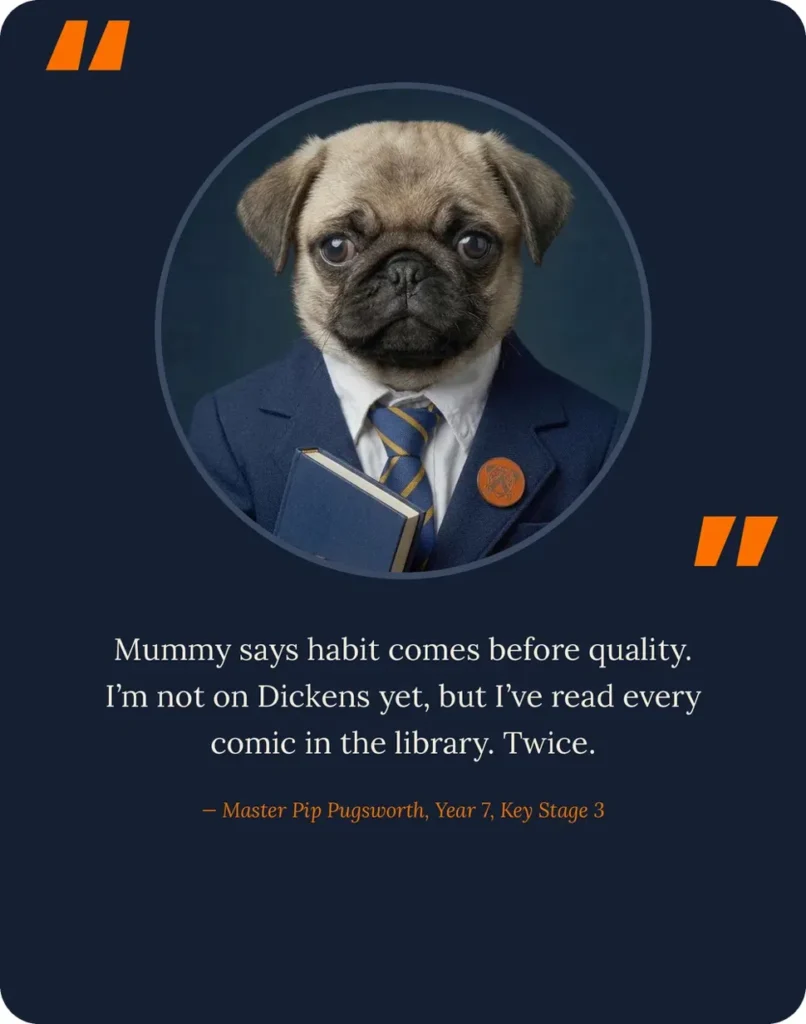
Parents often ask this, and the honest answer is: not at first. Habit comes before quality. A teenager who reads football novels every night is building more than one who has abandoned a “worthy” classic on chapter two.
Once the habit is there, you can stretch it gradually. Move towards books with richer language, more complex narrators, or slightly older readers in mind. The aim is a slow upward drift, not a sudden jump to Dickens.
What parents can actually do
For younger children (11+ age):
- Keep reading aloud to them even after they can read alone. The same research found that children who were read to regularly at age 5 did better in all three tests at 16. ucl
- Make library visits a regular routine. Libraries are free, and letting a child choose for themselves matters.
For teenagers (IGCSE and A-Level):
- Count audiobooks. They build vocabulary and story sense, and they fit into a commute or a gym session.
- Let them read on a phone or e-reader if that’s what gets them reading.
- Use what they already love. A series they’re watching may have been a book first, or there may be a novel in the same genre.
- Read where they can see you. Teenagers notice what adults actually do much more than what they say.
- Don’t turn reading into homework or a punishment. Children who learn to see reading as a chore rarely become readers.